
4.1K
Downloads
98
Episodes
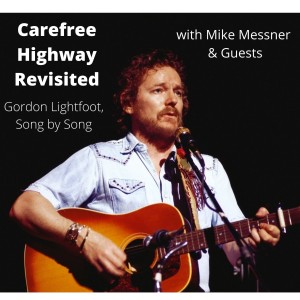
Hello folk music fans! Gordon Lightfoot is one of the greatest folk-rock artists of all time. And now there's a podcast celebrating and discussing his work, song by song. Every episode, your host (that's me, Mike Messner) will examine one of Gordon's songs with the help of a special guest! So if that's your cup of tea, give us a listen and give us a follow. We'll see you on the Carefree Highway!
Episodes

Tuesday Sep 07, 2021
Tuesday Sep 07, 2021
In this episode, host Mike Messner and his guest Liz Castillo discuss "Rainy Day People" from Gordon Lightfoot's 11th album, Cold On The Shoulder.
Saturday Aug 21, 2021
Saturday Aug 21, 2021
In this episode, Mike and guest Kevin McLear discuss "For Lovin' Me," from Gordon Lightfoot's debut album, Lightfoot!.
Monday Jul 19, 2021
Monday Jul 19, 2021
In this episode, host Michael Messner and his guest, Adele Chalifoux, discuss "Approaching Lavender" from Gordon Lightfoot's sixth album, Sit Down Young Stranger (later renamed If You Could Read My Mind).
Thursday Jul 01, 2021
Thursday Jul 01, 2021
In this episode, Mike Messner and his guest, Terry Wick Machowski, examine and discuss Gordon's 1972 song "Beautiful," from his eighth studio album, Don Quixote.
Friday Jun 18, 2021
Friday Jun 18, 2021
In this episode of Carefree Highway Revisited, we turn our attention to one of Gordon Lightfoot’s most enduring and widely covered songs: “Early Morning Rain.”
I’m joined by my longtime friend Pete Fullerton, former bassist and vocalist for We Five, whose band recorded one of the most well-known early cover versions of the song on their 1970 album Catch the Wind. What follows is a deeply personal and musically informed conversation — not just about the song itself, but about the life experiences that give it meaning.
Pete talks about what first drew him to the music of Gordon Lightfoot: its honesty, simplicity, and emotional truth. We discuss how “Early Morning Rain” captures a universal feeling — being far from home, low on money, worn down, and longing for connection — without ever becoming indulgent or overstated.
Our conversation explores:
- Why Lightfoot’s songwriting feels unpretentious and truthful
- The circumstances that led We Five to record “Early Morning Rain”
- The camaraderie and professionalism behind the making of Catch the Wind
- How shared experiences of travel, exhaustion, and homesickness shaped their interpretation
- Subtle lyric changes in We Five’s version — and why they felt authentic rather than cosmetic
- The song as a jet-age parallel to older hobo and railroad imagery
- How vocal harmonies, crescendos, and arrangement choices help tell the story emotionally
We also dig into the song’s structure and restraint — how it says exactly what it highlight needs to say and then gets out, avoiding excess instrumentation or showmanship. Pete reflects on how “Early Morning Rain” manages to sound upbeat even while telling a story of disappointment and helplessness, and why that balance feels true to life.
Later in the episode, we compare different recordings of the song , discuss vocal maturity, tempo, arrangement, and why artists sometimes feel compelled to revisit earlier work once they’ve grown into it.

Wednesday Jun 09, 2021
Wednesday Jun 09, 2021
In this episode of Carefree Highway Revisited, we take on one of the most ambitious and sweeping songs in the Gordon Lightfoot catalog: “Canadian Railroad Trilogy.”
I’m joined by fellow Lightfoot fan and interpreter John McLaughlin, whose lifelong connection to the song began in a Canadian history classroom in 1970. From that first exposure, “Canadian Railroad Trilogy” became both a musical and historical touchstone, shaping John’s appreciation for Lightfoot’s work and inspiring him to eventually learn the song himself.
Our conversation explores the song as:
- A commissioned historical piece written for Canada’s 1967 centennial
- A work of national identity and optimism, rooted in a specific historical moment
- A rare example of a popular song functioning as serious narrative history
We dig deeply into the lyrics, as always, and we each add some historical perspective from our own native side of the bordeer. We also explore the musical architecture of the song: Its three-part structure and shifting tempos; the dramatic pauses — especially the long silence before the final line; and differences between the original The Way I Feel recording and the later Gord’s Gold version.
Thursday May 27, 2021
Thursday May 27, 2021
In this episode of Carefree Highway Revisited, I’m joined by Deb Radwan, a longtime fan and major contributor to the Gordon Lightfoot Gold Facebook group. We talk about how “Song for a Winter’s Night” creates an almost physical sense of place and how Lightfoot’s lyrics function less like a pop song and more like a self-contained poem. Deb describes being drawn to Lightfoot’s work primarily through his words, and why this song stands near the very top of his catalog for her.
Our conversation explores why this song feels especially powerful in small, intimate settings; how Lightfoot’s imagery transports listeners into the emotional space of longing and connection; the contrast between the romantic winter imagery of the song and the mundane summer setting in which it was actually written; the experience of rereading letters and missing someone in a pre-internet world; and the subtle but meaningful role of the sleigh bells at the end of the song — including confirmation from Gordon himself that they signal a joyful reunion.
Deb and I also discuss differences between the original The Way I Feel recording and the later Gord’s Gold version; how production choices affect the emotional impact of the song, and the importance of Lightfoot’s bandin shaping the sound of his early work.
Thursday May 13, 2021
Thursday May 13, 2021
Welcome to the very first episode of Carefree Highway Revisited. I’m Mike Messner, and in this pilot episode I take some time to explain why this podcast exists, why Gordon Lightfoot’s music matters so much to me, and why now (May 2021) felt like the right moment to finally do this.
I grew up on the music of Gordon Lightfoot. One of my earliest musical memories is hearing “Don Quixote” from Gord’s Gold when I was just a few years old — a song that immediately grabbed me with its swing, melody, and storytelling. That connection only deepened years later when I started playing guitar and tried (somewhat clumsily) to learn “If You Could Read My Mind.”
This episode isn’t a song breakdown yet. Instead, it’s about:
-
Why I’m drawn to long-form, thoughtful podcasting
-
How shows like Pod Dylan inspired the idea of a song-by-song format
-
My own background as a teacher, amateur guitarist, and lifelong listener
-
Why Gordon Lightfoot deserves deeper discussion in the podcast world
-
How discovering other fans online helped push this idea forward
I also talk about the reality of making this show — recording when time allows, especially at the end of a school year and during a moment of transition coming out of the COVID era. This podcast is meant to be unhurried reflective and driven by genuine affection for the music rather than hype or production schedules.
Looking ahead, I invite listeners to be part of the journey. If you have a particular Gordon Lightfoot song that matters to you, I’d love to hear from you and, eventually, bring voices like yours into the conversation.